The Robot Playbook · Book 1
It works on my machine.
Your first site with an AI agent, from the idea to live.
The demos are real. An AI agent will build you something impressive in an afternoon. Then it sits on your laptop, because nobody films the rest: the deploy that fails three times, the domain that eats a weekend, the moment you realize you have no idea whether it's safe to show anyone. This book is that part, step by step, with the agent doing the typing and you making the calls.
Get the book, $19PDF, ePub, printable worksheets and the Start Here Kit · All sales final
Secure checkout by Whop. Your files arrive by email right after you pay. Details in Privacy.
Read Chapter 13 freeThe Robot Playbook · Book 1
Start Here:
It Works on
My Machine
Your first site with an AI agent, from the idea to live
A field workbook · Early Edition · A founder's story
Mark Wetherell
Everyone shows you the afternoon. Nobody shows you the two weeks.
I spent a career testing other people's software, which means I spent a career being told "well, it works on my machine." It was always true. That was always the problem.
There's your computer, where things work. And there's the world, where a stranger types your address on a phone in a parking lot and it either comes up or it doesn't. Everything that goes wrong lives in the gap between those two, and almost none of it is hard. It's just unfamiliar, and unfamiliar is where people quit.
This book walks the gap. Sixteen chapters, from an idea you keep working around by hand to an address you can text to a friend.
The road, in order.
- Part 1. The idea, before you install anything. Find the thing you keep doing by hand. Work out whether it's really missing. Pick the one question your thing answers, and park everything else. Set up two AI seats and the chair you sit in.
- Part 2. The workshop, set up once. What you need and what it costs per month. Locking your accounts before there's anything worth stealing. Editor, terminal and git, Mac and Windows side by side. Installing your agent and briefing it.
- Part 3. The build, empty folder to live. First commit. Starting from a template without inheriting someone else's problems. Making it yours and making it true. Checks that run without you. Putting it on the internet. Your own address, without breaking your email. Opening the doors.
- Part 4. Keep it alive. The loop you'll use forever: one change, prove it, push it, watch it land.
Nineteen sheets, made for a pen.
The printables are laid out for a home printer, one job per page: the gap page, the research sheet, the one-question page, your working agreement, accounts and costs, the setup check, a tick-sheet for every build chapter, the DNS sheet and the launch checklist.
The accounts sheet and the DNS sheet are the two you'll be glad to have on paper. One of them is the reason you'll still have email at the end of Chapter 14.
What you get.
- The book. PDF and ePub. Sixteen chapters in four parts, about 27,000 words.
- Nineteen printable sheets. A separate PDF, made for a home printer.
- The Start Here Kit. Thirteen template files: the prompts for every build chapter, a working agreement to start from, the recon and read-the-log prompts, and the loop card to pin up.
- Free updates. You're buying the Early Edition. When I revise it, you get the new files.
- A whole chapter, free. Read Chapter 13 before you buy.
This is for you if
- You've watched someone build an app with AI in a weekend and never managed to get anything live yourself.
- You can use a computer confidently but you've never opened a terminal, or you did once and closed it again.
- You have an idea you keep doing by hand, and you're tired of it.
- You'd rather understand what you built than end up with something you're afraid to touch.
It's not for you if
- You already have something live and the question is how to work faster or with several agents at once. That's Book 2.
- You want to ship something this weekend and never look at it again. You don't need any of this.
- You're looking for a way to make money quickly. I don't know how to do that, and I'd be suspicious of anyone who says they do.
Real pages, and a whole chapter free.
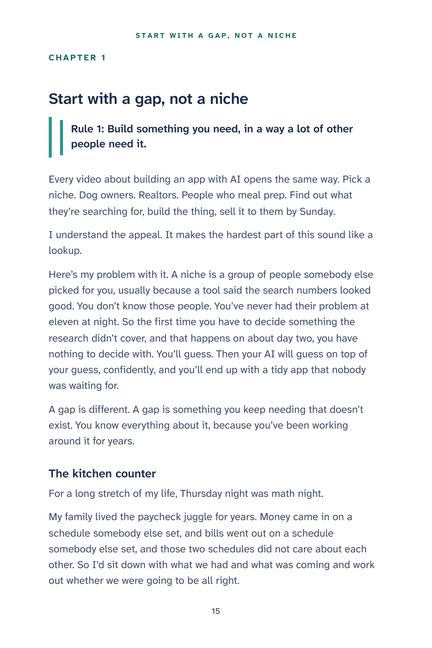
Chapter opener. Every chapter starts from one rule. 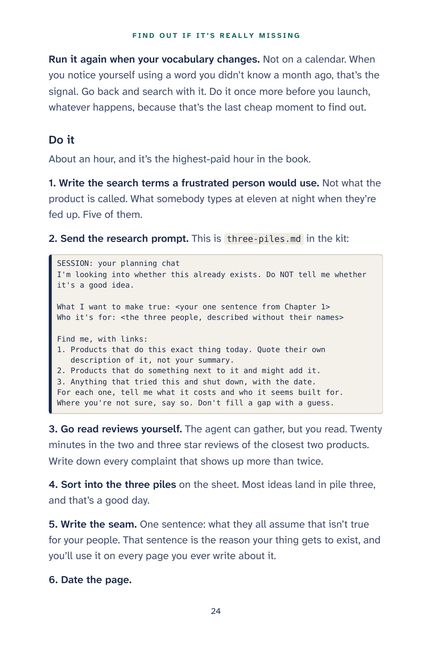
Prompts you paste. Complete, labeled, nothing to fill in but your own project. 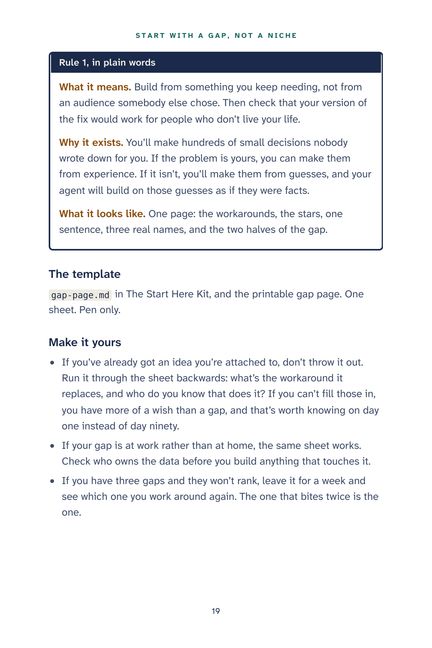
The rule, in plain words. What it means, why it exists, what it looks like. 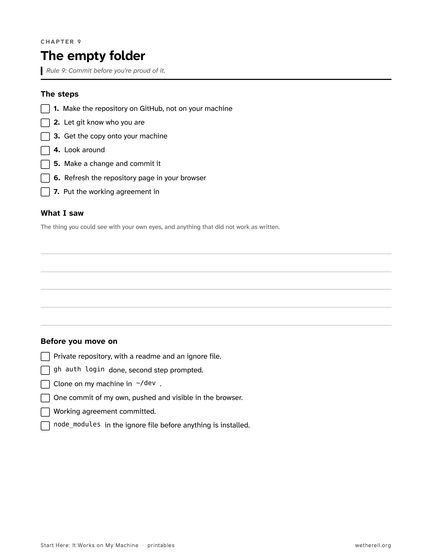
Printable worksheets. One per build chapter, made for a pen.


The whole chapter, including the part where my first deploy failed twice and what the error messages actually meant.
Why listen to me.
I started in accounting, then spent a career building and testing software, much of it on Scrum teams. My family lived the paycheck juggle for years, so I built PocketSense: an app that answers one question, will I make it to payday. It runs in production, in two countries, and real people's money depends on it being right.
I built it with AI agents. Then I built this site, the one you're reading, from an empty folder in the afternoon to live that evening, to find out whether the method held up from nothing. It did. This book is every step of that day, written down.

The Robot Playbook
Three books, one road. Read them in any order. Each stands on its own.
Book 1 · Start Here: It Works on My Machine.
Your first site with an AI agent, from the idea to live. $19.
Book 2 · Level Up: Don't Let the Robot Push to Main.
The way of working that keeps a team of agents honest. $27.
Book 3 · Ship It.
What it takes to go to market. Planned.
Start here.
An idea, an evening or two a week, and a stubborn streak. That's the entry requirement.
Get the book, $19PDF, ePub, printable worksheets and the Start Here Kit · All sales final
Secure checkout by Whop. Your files arrive by email right after you pay. Details in Privacy.
Questions
- Do I need to know how to code?
- No. You need to be comfortable using a computer and willing to type what the book tells you to type. The agent writes the code. Your job is deciding what gets built and checking the work, which is a different skill and the one that matters now.
- What will I actually have at the end?
- A small site of your own, live at an address you bought, that you understand and can change. Plus the habits that make changing it safe: a project with history, checks that run on their own, and a way of working with an agent that doesn't depend on trusting it.
- Mac or Windows?
- Both. Where the steps differ, the book splits them into two columns. Windows readers get the one piece of advice that saves the most grief, which is about where your files actually live.
- What does it cost to run what I build?
- At this size, very little. Most of what you need is free, hosting is a few dollars a month, and a domain is ten to twenty dollars a year. The one bill that scales with how you work is the AI itself, and Chapter 5 is about counting all of it before you start.
- How long does it take?
- A few evenings a week for about a month, if you're doing it rather than just reading. Part 1 is thinking, Part 2 is setup you do once, and Part 3 is the build.
- Which tools does it use?
- Claude Code for the agent, GitHub for the code, Railway for hosting, and a free template called AstroWind to start from. I name them because a step-by-step book that won't tell you what it used is no use to anybody. I'm not affiliated with any of them and nobody paid for a mention. Every chapter says what to look for if you'd rather use something else.
- Should I read this or Book 2 first?
- If you've never got anything live, start here. If you already build with agents and your problem is "it said it was done and it wasn't," skip to Book 2. They're written to stand alone, so either order works.
- Can I get a refund?
No, and I'd rather say why than bury it. The files download the moment you pay, so there's nothing to give back. That's why a whole chapter is free: read Chapter 13 first, and if the writing isn't for you, you've lost nothing.
If something is actually wrong, a file won't open, you were charged twice, you bought the wrong book, email me at mark@wetherell.org and I'll fix it. That isn't a refund policy, it's me not keeping money for something that didn't work.